

Search engines don’t treat a link as a single “SEO point.” When you look at how search engines evaluate links, they’re really doing two separate jobs: finding your pages, and judging how much to trust them.
If you launched a startup site, published solid content, and still see zero rankings, the problem is often simpler than you think — Google may not even know your pages exist. Google’s own documentation says the vast majority of pages in Search are found automatically when crawlers follow links from known pages or read submitted sitemaps.[1] No links in, no discovery path.
Here’s what this article covers:
- The three stages links affect — crawling, indexing, and serving — and why a link that gets found doesn’t automatically get ranked.[1]
- The four link signals you can actually influence: domain authority, topical relevance, how the link was obtained, and anchor text plus placement.
- What Google explicitly penalizes — link spam is a named policy violation, enforced by automated systems and human reviewers.[2]
- A five-question checklist to judge any link source — including startup directories — in under five minutes.
- Why link quality still matters now that AI-driven answers are reshaping discovery.
One expectation to set up front: Google says search relevancy is determined by hundreds of factors.[1] Links matter a lot. They are not a single lever you pull. This guide is written for pre-seed to Series A founders doing their own SEO, and for agencies handling client off-page work.
1. How Search Engines Evaluate Links Across Three Stages: Crawling, Indexing, Serving
Google Search works in three stages — crawling, indexing, and serving search results — and not every page makes it through all three.[1] Links influence each stage differently, which is why “I built backlinks and nothing happened” usually means the links failed at a stage you weren’t watching.
“Google doesn’t accept payment to crawl a site more frequently, or rank it higher. If anyone tells you otherwise, they’re wrong.”
Crawling: How a Link From a Known Page Gets Your Startup Discovered
Googlebot uses an algorithmic process to decide which sites to crawl, how often, and how many pages to fetch from each one.[1] A brand-new domain with almost no referring pages gives that process very little to work with. An external link from a site that already gets crawled regularly is a shortcut into the queue.
One technical detail worth knowing: Googlebot renders pages and runs JavaScript using a recent version of Chrome.[1] Rendering happens, but it isn’t instant or guaranteed. A link inside a plain HTML anchor is more reliable than one injected by a client-side widget or hidden behind a click. Practically: a startup directory listing that renders your URL server-side is worth more than one loaded by script after the page loads.
Indexing and Serving: Why Getting Linked Is Not the Same as Getting Ranked
This is the answer to the most common founder complaint — “my backlinks aren’t getting indexed.” Crawling, indexing, and serving are separate steps, and a page can be crawled and still never be indexed or served.[1] If a directory profile page is thin, near-identical to thousands of others, or blocked from crawling, the link on it may never carry any weight.
Google also states plainly that following its Search Essentials guarantees nothing.[1] That’s your rebuttal to any vendor selling “guaranteed #1 rankings” — nobody can buy crawl frequency or position.
So if links can’t be bought safely, what makes one worth pursuing? The signals below.
2. How Search Engines Evaluate Links: The Four Signals That Matter
The core idea is old and still holds: search engines assess backlinks to gauge a site’s popularity, authority, and relative importance on the web, and PageRank treats a hyperlink as a vote of confidence.[3] Not all votes count the same.
Four signals you can realistically influence:
- Authority of the linking domain — how trusted and well-linked the referring site is.
- Topical relevance of the linking page — does the page’s subject match yours?
- How the link was obtained — earned or genuinely listed, versus purchased or auto-generated.
- Anchor text and surrounding context — what the words around the link say about you.
On the numbers side, Backlinko data cited by Bruce Clay found the No. 1 Google result has on average 3.8 times more backlinks than results in positions 2 through 10.[3] Read that as correlation, not a recipe. Pages that rank first tend to attract more links because they rank first.
Search engines count both quantity and quality when deciding which pages surface in results,[4] but sites with fewer high-quality links regularly outrank sites with more low-quality ones.[3]
Relevance and Authority: Why 10 Fintech Links Beat 100 Generic Ones
Link popularity combines the number of linking sites with their authority, and links from unrelated sites can look unnatural.[3]
Concrete example: a SaaS payroll tool listed in an HR-tech directory sends a coherent topical signal — the category, the neighboring listings, and the audience all line up. That same tool dumped on a generic “useful web links” page sends almost nothing, because nothing in the context says “payroll software.”
The outbound side counts too. Linking out to quality, topically aligned sources supports your own page quality.[3] That cuts both ways — it’s also how you size up a directory’s outbound links before you submit.
Anchor Text and Placement: What a Natural Link Profile Looks Like
A natural profile is mostly branded anchors (“SR Booster”, “srbooster.com”), some naked URLs, some generic phrases, and a small share of descriptive keyword anchors. A profile where 80% of anchors are the exact phrase you want to rank for stands out immediately.
Placement is evaluated, not just counted. Google’s spam documentation lists hidden text and link abuse examples like linking only one small character, positioning text off-screen with CSS, and setting font size or opacity to zero.[2] Those examples exist because search systems look at where and how a link appears, not just that it exists.
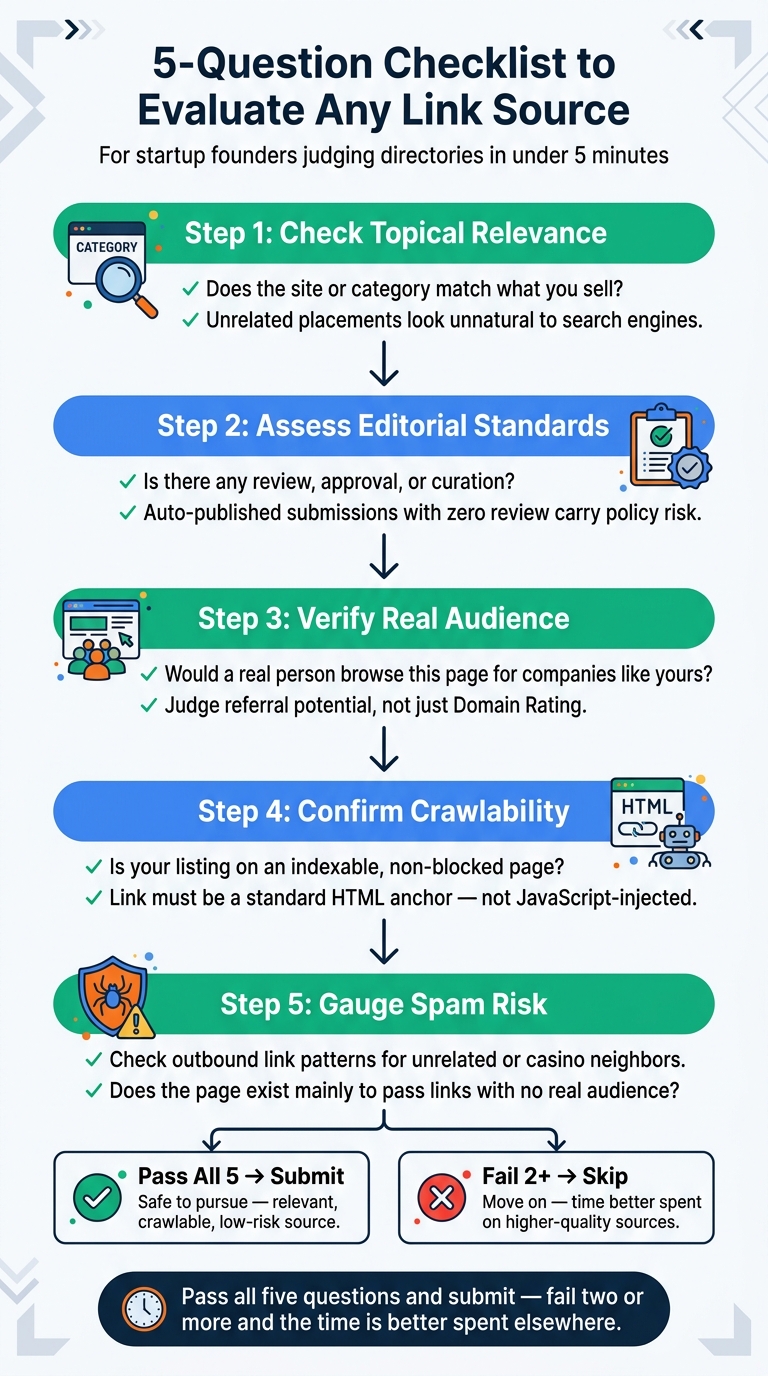
5-Step Link Source Evaluation Framework for Startup SEO
3. What Search Engines Penalize: Link Spam in Google’s Own Words
Google defines spam as techniques used to deceive users or manipulate Search systems into featuring content prominently — a definition that now explicitly includes attempts to manipulate generative AI responses in Search.[2] Link spam is named directly as a policy-violating behavior, and sites that violate the policies may rank lower or not appear at all, with enforcement through automated systems plus human review that can lead to manual action.[2]
The patterns founders get sold most often:
- Paid link packages — “500 backlinks for $99.”
- Link farms and sitewide footer links across unrelated networks.
- Hidden links via CSS positioning or one-character anchors.[2]
- Doorway pages built only to funnel traffic.[2]
- Links from unrelated sites, spam sites, and pages that openly sell links.[3]
The practical line for directories: a directory that exists only to pass links — no audience, no review, everything auto-published — carries policy risk. A directory that genuinely helps people find companies does not.
Comparison Table: Legitimate Link Earning vs. Manipulative Link Schemes
| Attribute | Legitimate Link Source | Manipulative Link Scheme |
|---|---|---|
| How the link is obtained | Editorial review, application, or a genuine company listing | Purchased, swapped in bulk, or auto-generated |
| Audience | Real visitors; sends referral traffic | No human audience at all |
| Relevance | Topical, industry, or geographic fit | Any site accepted, any category |
| Link placement | Visible in-content or in a profile field | Hidden by CSS, sitewide footer, one-character anchor |
| Site’s other outbound links | Curated and related | Unrelated bulk, casino and pharma neighbors |
| Risk under Google spam policies | None | Demotion or removal from results |
For the complete list of prohibited behaviors, see Google’s spam policies for web search.
Those attributes turn neatly into a checklist you can run on any site.
4. A Five-Point Checklist for Judging Any Link Source (Including Startup Directories)
This is where Google’s documentation becomes a decision you can make in a few minutes per site. Open the directory, answer five questions, then submit or move on.
The Five Questions: Relevance, Editorial Standards, Audience, Crawlability, Spam Risk
- Relevance. Does the site or category match what you sell, who you sell to, or where you operate? Unrelated placements look unnatural.[3]
- Editorial standards. Is there any review, approval, or curation — or does every submission publish instantly? Invert Google’s list of prohibited tactics and you get a decent definition of a safe source.[2]
- Audience. Would a real person plausibly browse this page looking for companies like yours? Judge referral potential, not just Domain Rating.
- Crawlability. Is your listing on an indexable page? Is the link a standard HTML anchor, visible without JavaScript execution or a user click?[1]
- Spam risk. Check the site’s outbound link patterns, whether it openly sells placements, and whether the page exists mainly to pass links.[2][3]
Scoring rule: pass all five and submit. Fail two or more and skip it — the time you’d spend on the listing is better spent elsewhere.
Where Startups Realistically Earn Their First 100 Links
- Startup and product directories organized by category
- Accelerator and incubator portfolio pages
- Industry associations and standards bodies
- Chamber of commerce and local business listings
- Integration and partner pages of tools you connect to
- Podcast and interview show notes
- Review platforms in your software category
- University and alumni founder pages
This mix works because it produces varied linking domains, plausible relevance, and actual referral traffic — which is what a natural profile looks like from the outside.
An outreach reality check: people generally won’t find a new site on their own, so proactive promotion is still required. Keep emails around 100–150 words, customize the first one or two sentences, and start with blogs and smaller companies before pitching large publishers.[4]
Time Cost and How SR Booster Fits
Be honest about the workload: running each directory through the five questions, creating accounts, writing listing copy that fits each form, uploading logos and screenshots, then tracking which submissions actually went live. This is the step most founders start and abandon around listing number fifteen.
If you’d rather not spend those weeks, SR Booster’s manual directory submission service covers 120+ relevant startup directories, picks them based on your profile’s actual category, and delivers a report with profile links, logins, and screenshots in roughly two weeks — including white-label options for agencies managing client off-page work.
One last objection worth addressing: do links still matter when more people get answers from AI?
5. Why Link Quality Still Matters as AI Search Changes Discovery
Researchers found that generative search engines often cite sources that would not appear anywhere in Google’s top 100 links.[5] That matters for startups: visibility is fragmenting, and a link strategy aimed only at classic blue-link rankings is fragile.
FTI Consulting reports that information discovery is no longer dominated solely by keyword-based search engines and has been transformed by social media and AI-driven systems.[6] Kantar’s guidance points the same direction: brands need broader visibility and brand signals as AI search reshapes how people find things.[7]
The practical conclusion is convenient: diversified, relevant mentions do double duty. A category directory listing, a review platform profile, a partner page, a podcast mention — each is a crawlable link for classic search and a citable source an AI system can pull from.
Conclusion: What to Do Next
Five things to carry forward:
- Links work across crawling, indexing, and serving — they get pages discovered, not just ranked.[1]
- Relevance and authority of the linking site outweigh raw link counts.[3]
- Link spam is an explicit policy violation with real enforcement, including manual action.[2]
- The five-question checklist — relevance, editorial standards, audience, crawlability, spam risk — is the fastest way to decide where to submit.
- Diversified, relevant mentions hold value as AI-driven discovery grows.[5][6]
Next action: pull your current referring domains, score each one against the five questions, drop what fails, then build a shortlist of category-relevant directories and partner pages to pursue this quarter. If the manual submission work is the part that keeps stalling, that’s exactly what SR Booster’s startup directory listings take off your plate.
FAQs
How do search engines evaluate backlinks?
They use links for discovery and for assessment. Crawlers follow links from known pages to find new ones, and ranking systems treat a link as a vote of confidence that reflects popularity, authority, and relative importance.[3] Weight depends on the linking site’s authority, topical relevance, and how the link was placed. Overall relevancy is determined by hundreds of factors.[1]
What makes a high-quality backlink?
It comes from a topically related site with real visitors, sits in visible content or a genuine profile field, uses a standard HTML anchor, and was earned or legitimately listed rather than bought. Sites with fewer high-quality links often outrank sites with far more low-quality ones.[3]
Are backlinks still relevant in 2026 with AI search?
Yes, and the target has widened. Research shows generative search engines frequently cite sources outside Google’s top 100 links,[5] while discovery is no longer dominated solely by keyword-based search.[6] Varied, relevant mentions serve both crawlers and AI answer systems.
Why aren’t my backlinks getting indexed by Google?
Crawling, indexing, and serving are separate stages, and not every page makes it through all of them.[1] If the page hosting your link is thin, near-duplicate, blocked, or renders the link only through JavaScript, it may never be indexed — so the link passes nothing. Check the host page’s own index status first.
Are startup directory submissions safe for SEO?
They’re safe when the directory genuinely helps people find companies — real audience, some curation, relevant categories, visible links. They become risky when the site exists only to pass links, since link spam is a named policy violation enforced by automated systems and manual review.[2] Run the five-question checklist before submitting.
Stop doing this manually
We list your startup in 120+ relevant directories — by hand
Every submission is done manually and delivered in a live report with profile links, logins and screenshots, so you can verify each backlink yourself. From $99, one-time.



Leave a Reply