

If Google decides one of your listings is a duplicate, it won’t show on Search or Maps at all[3]. That alone is reason enough to learn how to avoid duplicate directory listings before you submit your startup anywhere. And on the trust side, 62% of consumers say they would avoid a business entirely if they found incorrect information about it online[1].
Duplicates aren’t a cosmetic problem. They’re a data problem that quietly leaks the off-page SEO value you paid to build. Here’s the short version:
- A duplicate is any second listing for the same business on the same platform — even if the name, phone, or URL differ slightly[1].
- Duplicates split your ranking strength and your reviews across records instead of concentrating them on one authoritative profile[2].
- Prevention is cheap, cleanup is slow. One canonical business record plus a claim-vs-create check before every submission stops nearly all of them.
- Fixing them follows a clear order: remove duplicates you created, claim or merge the ones you don’t own, and update existing profiles after a move instead of creating new ones[3].
This is also why manual submission matters. When SR Booster lists startups across 120+ startup directories, duplicate control is part of the workflow instead of a cleanup job later. Below is the full system you can run yourself.
1. What Counts as a Duplicate Directory Listing (and What Doesn’t)
A duplicate listing is more than one listing representing the same business entity on the same platform. Slightly different details don’t make it a separate business — it’s still a duplicate[1].
The local SEO convention comes straight from Google’s guideline on pages per location, which Moz quotes directly:
“Do not create more than one page for each location of your business, either in a single account or multiple accounts.”
— Google guideline, cited by Moz[2]
Two profiles for one company aren’t two chances to be found. They’re conflicting records that make search engines guess which one is real[4].
Legitimate listings that look like duplicates
Don’t overcorrect and delete things you actually need. These are not duplicates[2]:
- Forward-facing departments that serve customers directly
- Individual practitioners at a multi-practitioner practice
- Separate buildings on a single campus
What doesn’t justify a new profile is a new service line. Google’s guidance for multi-service businesses is to list the services on the existing profile rather than spin up a profile for each one[3].
The startup rule of thumb: one profile per legal entity per location, with services listed inside it.
Where startup duplicates actually come from
Moz groups the causes into automation, accidents, data changes, spam, and simple lack of awareness — plus mergers, acquisitions, rebrands, office moves, and phone number changes where a marketer creates a fresh profile instead of editing the old one[2].
For early-stage companies, the triggers are painfully specific:
- Pivoting or renaming the product mid-campaign
- Moving from a coworking desk to a registered office address
- Switching from a founder’s personal email to a shared team email
- Running two submission services at the same time
- DIY submissions done before hiring an agency, with no record of what went where
Each one feels harmless in the moment. Each one costs you SEO value, which is what the next section quantifies.
2. How Duplicates Damage Off-Page SEO, Reviews, and Trust
Here’s what actually happens when the same startup exists twice on one platform:
- Ranking strength gets split. Instead of one strong profile, you get two weak ones competing[2].
- Review equity gets split. Reviews land on whichever record the customer found, which weakens trust signals and click-through. Clean up before you run any review campaign[2].
- The wrong listing can win. A duplicate can outrank your authoritative listing — and platforms may discover duplicates and remove listings themselves[2].
- Google suppresses duplicates outright from Search and Maps[3].
- Downstream damage adds up: NAP inconsistency, profile suspension, lost links from major directories, and fewer visitors and customers[1].
The link-building angle is the one most articles skip. When your citation profile is fragmented, the backlinks and mentions you earn from directory submissions point at competing versions of the same company. That makes the canonical record harder for search engines to consolidate, so authority spreads thin instead of stacking up[2][4].
If weak Domain Rating or backlinks that never move the needle sound familiar, duplicate records are a likely reason. Accurate business data is also getting more valuable, not less, as AI-driven local and answer search grows[6].
Evidence that cleanup moves rankings
Sterling Sky documented a ranking improvement shortly after a support-assisted merge of duplicate Google listings[5]. Treat that as an observed outcome, not a guarantee — results depend on your account structure and how Google processes the merged records.
The sequencing lesson is what matters: stabilize the entity first, then scale citations and backlinks. Doing it in reverse means paying twice.
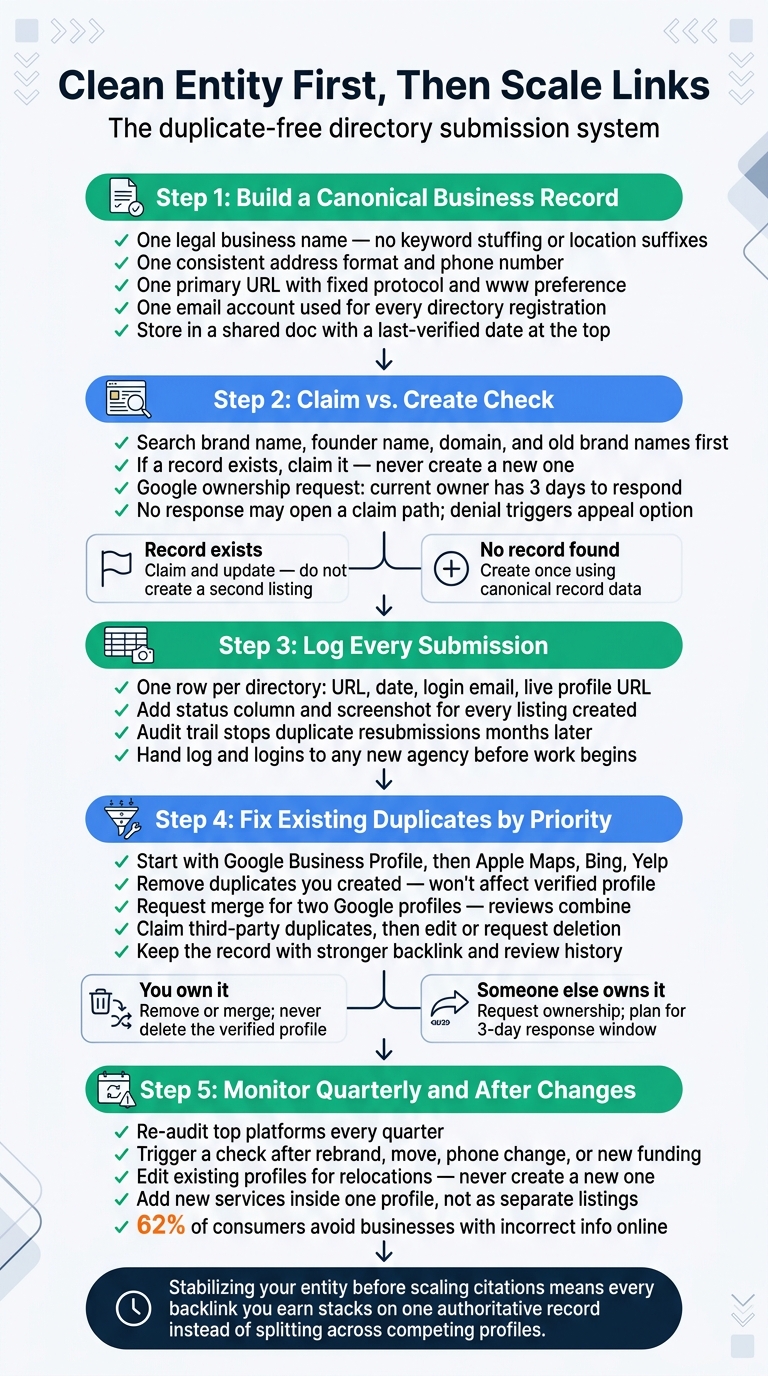
5-Step Duplicate Directory Listing Prevention Framework for Startups
3. The Prevention System: How to Avoid Duplicate Directory Listings Before You Submit
Most advice on this topic starts at cleanup. Start earlier. This pre-submission workflow takes an afternoon to build and works for every directory after that.
Build a canonical business record
Write down one approved version of every data point before you submit anywhere:
- Legal business name — no keyword stuffing, no location suffixes
- Address in one consistent format
- Phone number with consistent formatting
- Primary URL — pick one protocol and one www/non-www version, then stick to it
- Primary and secondary categories
- Short and long descriptions
- Logo files, founding year, and social profiles
- One email account used for every registration
Centralized data governance means one authoritative record distributed consistently, because every handoff between tools, agencies, or teammates increases mismatch risk[4]. Store it in a shared sheet or doc with a “last verified” date at the top.
Decide claim vs. create before every submission
Before you click “add your business,” search that directory for four things: your brand name, the founder’s name, your domain, and any old brand names. If a record already exists, claim it — don’t create a new one.
Google’s ownership path is concrete: a request goes to the current owner, who has 3 days to respond. Approval grants you access, denial gives you an appeal option, and no response may open a claim path[3]. Moved offices? Google says update the existing profile rather than create a new one[3].
Keep a submission log to stop duplicates at the source
One row per directory, six columns: directory URL, date submitted, login email, live profile URL, status, screenshot.
That’s the audit trail that stops someone from resubmitting six months later — and it’s exactly why SR Booster delivers a live report with profile links, logins, and screenshots for every listing it creates. BrightLocal makes a similar point for cleanup: record where duplicates were found and how they were resolved so the process is repeatable[1].
If duplicates already exist, that same log becomes your remediation map.
4. Finding and Removing Duplicate Directory Listings You Already Have
You probably can’t clean everything at once. Prioritize the most authoritative platforms first[2].
Audit: search by platform and by data variation
Search each platform using every variation your data has ever had: brand variations, old names, common misspellings, both addresses after a move, and old phone numbers[2].
Work in this order: Google Business Profile → Apple Maps → Bing Places → Yelp → data aggregators → the niche startup and industry directories where your profile equity actually lives. That last group is the one competitors underweight, and it’s where most startup backlinks come from. BrightLocal notes that a specialist local SEO tool can scan hundreds of listing sites, which beats manual spot checks for thoroughness[1].
Choose the right fix: claim, edit, merge, or remove
| Situation | Recommended action | Key caution |
|---|---|---|
| Duplicate you created yourself | Remove it — Google says it can be removed without affecting the verified profile[3] | Remove the correct one; linked managers and content disappear with it |
| Duplicate owned by someone else | Request ownership[3] | 3-day response window; plan for the appeal path if denied |
| Two Google profiles for the same business | Request a merge[3] | Reviews are combined, but review replies may be lost |
| Business relocated | Update the existing profile[3] | Never create a second profile for the new address |
| Multiple services or products | Add services to one profile[3] | A profile per service creates duplicates |
| Departments or individual practitioners | Leave them separate[2] | These aren’t duplicates — deleting them loses real visibility |
| Duplicate on a third-party directory | Claim it, then edit or request deletion via support[1] | Keep the record with the stronger backlink and review history |
Monitor on a fixed cadence
Re-check your top platforms quarterly, and again after every business change: rebrand, funding announcement, address change, phone change, new market.
Flawed data compromises decisions and any workflow built on top of it — a general data-quality principle that applies to citations as much as analytics[7]. Directory accuracy also carries consequences beyond SEO: reporting on Canada’s Indigenous Business Directory found that nearly $300M in federal contracts went to companies later removed from the directory, a reminder that listing integrity touches trust and compliance too[8].
The easiest way to keep this cadence manageable is to tie it to the events that cause duplicates in the first place.
5. Duplicate-Control Checklist for Common Startup Changes
- Rebrand or name change: edit existing listings one by one. Never re-submit under the new name.
- Relocation or coworking-to-office move: update the existing profile with the new address[3].
- Adding a second location: one profile per location — never two per location[2].
- New service or product line: add it inside the existing profile[3].
- Switching agencies or submission services: hand over the submission log and logins before any new work starts.
- Indexing follow-up: confirm the surviving profile is the one getting crawled and linked. Fragmented records waste the links you earned.
For agency and white-label work, the cheapest prevention available is agreeing on the canonical record before the first submission goes out — which is how SR Booster’s white-label directory submissions are scoped.
Conclusion: Clean Entity First, Then Scale Links
The takeaways:
- A duplicate is any second listing for the same entity on the same platform, even with slightly different details[1][2].
- Google hides duplicate profiles from Search and Maps, and 62% of consumers avoid businesses with incorrect information online[3][1].
- Duplicates split ranking strength and review equity instead of concentrating them[2].
- Prevention wins: one canonical record, a claim-vs-create check every time, and a submission log with profile URLs, logins, and screenshots.
- Fix existing duplicates in priority order — remove your own, claim or merge others, update after moves — then re-audit quarterly and after every change.
Fragmented citations weaken the exact off-page authority that directory submissions are supposed to build. Stabilize the entity, then scale the links.
If manual directory research and submissions are eating your week, that’s the part worth handing off. SR Booster manually lists startups on 120+ relevant directories and delivers a report with profile links, logins, and screenshots — so every listing is created once, correctly, and documented for the next person who touches it.
FAQs
What exactly counts as a duplicate directory listing?
Any situation where more than one listing represents the same business entity on the same platform. Slight differences in name spelling, phone formatting, or URL don’t make it a separate business — it still counts as a duplicate[1]. The convention traces back to Google’s guideline against creating more than one page per location[2].
How do I remove or merge a duplicate Google Business Profile?
If you created the duplicate yourself, you can remove it without affecting your verified profile — just be certain you’re removing the right one, since linked managers and content go with it. If two profiles exist for the same business, request a merge: reviews are combined, though review replies may be lost[3]. Sterling Sky observed a ranking improvement shortly after a support-assisted merge, though that’s one outcome, not a guarantee[5].
How can I find duplicate listings across multiple directories?
Search each platform manually using brand variations, old names, misspellings, both addresses if you’ve moved, and previous phone numbers[2]. A specialist local SEO tool can scan hundreds of listing sites, which is more thorough than manual spot checks[1]. Record what you found and how you resolved it so the audit is repeatable next quarter.
What is the difference between a duplicate profile and a separate business location?
A separate location has its own address and gets its own profile — one per location, never two[2]. Forward-facing departments, individual practitioners in a multi-practitioner practice, and separate buildings on a campus are legitimate listings, not duplicates[2]. Multiple services, on the other hand, belong inside one profile rather than on separate ones[3].
Do duplicate directory listings hurt my backlinks and off-page SEO?
Yes. Duplicates split ranking strength across records instead of concentrating it, and a duplicate can even outrank your authoritative listing[2]. Other consequences include NAP inconsistency, profile suspension, and lost links from major directories[1]. Because duplicates are conflicting records, search engines have a harder time consolidating your earned mentions into one canonical entity[4].
Stop doing this manually
We list your startup in 120+ relevant directories — by hand
Every submission is done manually and delivered in a live report with profile links, logins and screenshots, so you can verify each backlink yourself. From $99, one-time.



Leave a Reply