

A brand new site with no backlinks can rank for one thing: its own name. That’s the constraint most founders hit after publishing 20 good blog posts and seeing nothing happen. Domain Rating (DR) is the number that explains why — and domain rating for startups is less about the score itself than about the backlink profile sitting underneath it.
Here’s the short version of everything below:
- DR is Ahrefs’ 0–100 estimate of your backlink profile strength — not a Google ranking factor.[1]
- Only followed links move it. Nofollow, sponsored, and UGC links do nothing for DR.[1]
- The scale is logarithmic, so going from DR 0 to the teens is dramatically easier than DR 69 to 70.[1]
- Sequence beats volume: foundational directory and profile links first, then linkable content and outreach, then internal linking to your money pages.[2]
- A directional six-month target is DR 15–30 for a startup combining directory submissions with content.[2]
Context matters too. TechCrunch counted 55 US AI startups that each raised $100M or more in 2025, which tells you how much funded competition is now buying content and links in the same search results you’re targeting.[5] So treat DR as a readout, not a goal — the actual work is acquiring followed links from relevant, authoritative domains.
1. What Domain Rating Actually Measures
DR is a score from 0 to 100 that Ahrefs assigns to a domain based on the strength of its backlink profile. Google doesn’t use it. Ahrefs built it so you can compare sites at a glance.[1]
Three inputs drive the number[1]:
- How many unique websites link to you (referring domains, not total links).
- The DR of those linking websites.
- How many sites each of those domains links out to.
That third input is the one founders miss. A followed link from a strong site that links out to very few places carries more weight than dozens of links from pages stuffed with hundreds of outbound links. Ten links from ten different quality domains beat 200 links from one link farm.
The scale is also logarithmic. Moving from DR 9 to DR 10 is far easier than DR 69 to DR 70, and a DR 20 site is more than twice as authoritative as a DR 10 site.[1] For a startup, that’s good news: the first gains are the cheapest you will ever buy.
DR vs. Domain Authority vs. PageRank
Quick clarification, because these get mixed up constantly:
- Domain Rating (DR) — Ahrefs’ metric.
- Domain Authority (DA) — Moz’s metric.
- PageRank — Google’s internal system, not publicly visible.
DR and DA are third-party estimates of backlink strength. Use them to benchmark competitors and to vet link prospects. Don’t treat either as a score Google is looking at.
So if Google ignores DR, why should a pre-traffic startup care about it at all?
2. Why Domain Rating Matters for Startups Before You Have Traffic
Because it lines up with what you can realistically rank for. SubmitWell’s practical bands are a useful directional guide[2]:
| DR band | What you can realistically rank for |
|---|---|
| 0–10 | Branded searches only |
| 10–25 | Very specific long-tail queries |
| 25–45 | Medium-competition keywords |
| 45+ | Competitive head terms become achievable |
These are vendor estimates, not guarantees — a low-competition niche can beat them and a crowded one won’t. But they explain the pattern where good content on a DR 3 site gets zero traffic and zero leads.
There’s a second reason, and it has nothing to do with rankings. SubmitWell argues that a startup still sitting at DR 0 after six months raises questions for investors, partners, and journalists who check backlink footprints.[2] Every founder eventually gets asked “where have you been featured?” — and a thin backlink profile is a visible answer. Building an early off-page SEO footprint is partly a credibility exercise, not just an SEO one.
SubmitWell also connects stronger site authority to better trust signals on landing pages and more efficient paid media.[2] Treat that as a plausible side benefit rather than a proven mechanism, but it’s a reason not to ignore off-page work while you scale ads.
Which raises the question most people get wrong: which links actually count?
3. Which Links Move DR and Which Do Not
Here’s the single most misunderstood point in link building: UGC, sponsored, and nofollow links do not improve DR.[1] A “listing” isn’t automatically a DR gain. The link attribute and the host domain decide that.
“The only thing that really matters is getting high-quality backlinks from authoritative websites.”
— Joshua Hardwick, Former Head of Content, Ahrefs[1]
So build an audit habit. Before you submit anywhere, check three things:
- The directory’s own DR — is there any authority to pass?
- The outbound link attribute — followed, or
rel="nofollow"/ugc? - Whether profile pages get indexed — an unindexed page passes nothing, no matter how it’s marked up.
That last one is where a lot of budget quietly disappears. Backlinks that never get indexed are, for DR purposes, backlinks that don’t exist.
| Link source | Typically followed? | Effect on DR | Other value |
|---|---|---|---|
| Followed listing on an indexed, moderate-DR startup directory | Yes | Positive[1] | Referral traffic, discovery, early credibility |
| Nofollow / UGC directory or forum profile | No | None[1] | Some traffic, brand mentions |
| Sponsored or paid placement | Marked sponsored | None[1] | Audience reach, possible conversions |
| Social media profile link | Usually nofollow | None[1] | Brand consistency, traffic |
| Press mention or partner page | Often followed | Positive when followed | Strong trust signal, referrals |
| Self-published guest post on a low-quality site | Sometimes | Negligible | Little to none |
Takeaway: submission volume alone is a weak target. Followed links from relevant, indexed, reasonable-authority domains are the target — which is why vetted startup directory submissions beat blasting your URL at 500 random link pages.
With that filter in place, here’s the order to build in.
4. A Zero-to-First-Authority Off-Page Roadmap
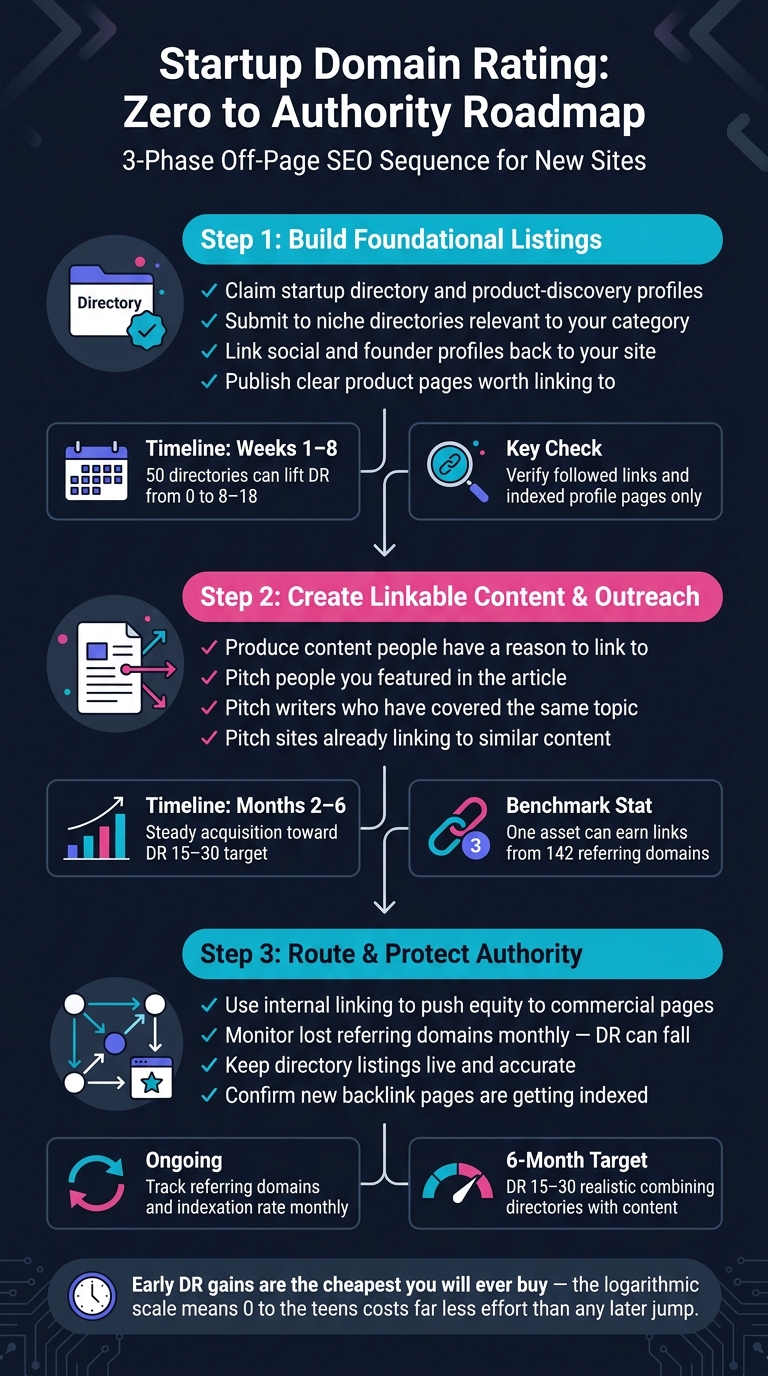
This sequence matches how startup budgets actually work: foundational links first, compounding links second.[2]
Phase 1 (weeks 1–8): Foundational listings and profiles
- Claim startup directory and product-discovery profiles.
- Submit to relevant niche directories in your category.
- Link social and founder profiles back to the site.
- Publish clear product and pricing pages that are actually worth linking to.[2]
Directories fit this phase for a specific reason: they’re repeatable, they don’t require relationships or a content library, and they create the visible backlink footprint your later outreach depends on. Nobody links to a site with zero referring domains.
The cost is time. Researching directories, finding submission forms, writing listing copy, and managing logins is slow, manual work. That’s the gap a done-for-you service fills — SR Booster manually builds 120+ startup directory listings and delivers a report with profile links, logins, and screenshots in roughly two weeks.
Realistic outcome for this phase, per SubmitWell’s estimate: a 50-directory run can lift DR from 0 to roughly 8–18 by weeks 4–8.[2] Vendor claim, so hold it loosely — but it’s directionally consistent with how cheap early DR gains are.
Phase 2 (months 2–6): Linkable content and targeted outreach
Ahrefs’ method has three parts: create content people have a reason to link to, pitch it to relevant and authoritative sites, and use internal linking to route authority to the pages you want to rank.[1]
For prospecting, Ahrefs names three groups worth pitching[1]:
- People you featured in the article.
- People who have written about the topic.
- People who already link to similar content.
Does content actually earn links? Ahrefs cites one of its own posts that earned 667 organic visits and links from 142 websites.[1] Note the ratio — modest traffic, a lot of referring domains. That’s a link asset, not a traffic play.
Phase 3 (ongoing): Protect and route the authority you have
Ahrefs warns that links pointing at random pages won’t necessarily improve rankings or traffic, and recommends internal linking — its “Middleman Method” — to push equity toward commercial and comparison pages.[1]
Maintenance list:
- Monitor lost referring domains — DR can fall.
- Keep directory listings live and accurate.
- Check that new backlink pages are getting indexed.
One prerequisite sits underneath all of it: crawlable, fast, reliably hosted pages. If your site is slow or flaky, indexing suffers and link building can’t compound. TechRadar’s 2026 round-up tested 60 hosting platforms, which is a reasonable starting point if you’re still choosing one.[6]
Now, what numbers should you actually expect?
5. Realistic Domain Rating Benchmarks and Timelines for Startups
SubmitWell suggests DR 15–30 is a realistic target for a six-month-old startup that combines directory submissions with content marketing.[2] Results vary widely based on how competitive your niche is and how fast you’re adding new referring domains.
DR also lags reality. A new backlink only registers after the linking page is crawled and indexed, so refreshing your DR score weekly is a waste of attention. Track leading indicators instead:
- New referring domains per month
- Followed vs. nofollow split
- Indexation rate of new backlinks
And a reality check on “DR 30 in 14 days” offers: practitioner accounts of improving domain authority describe months of consistent content production and steady link acquisition, not one campaign.[3][4] Anything faster usually means links that won’t survive an audit.
3-Phase Domain Rating Growth Roadmap for Startups
Conclusion: Key points to act on
- DR is a readout of your backlink profile — driven by how many domains link to you, their own DR, and how much they link out.[1]
- Only followed links move it. Vet directories for link attributes and indexation before submitting.[1]
- The scale is logarithmic, so 0 to the teens is the fastest, cheapest progress you’ll ever make.[1]
- Sequence: foundational listings and profiles, then linkable content and outreach, then internal linking to commercial pages.[2]
- Use DR 15–30 at six months as a direction, and report referring domains and indexation monthly.[2]
If Phase 1 is the part you keep postponing because the manual research eats your week, that’s the piece worth handing off. SR Booster’s startup directory listing service covers the foundational layer so you can spend your own time on the content and outreach that compounds later.
FAQs
What is considered a good Domain Rating for a startup?
It depends on your age and niche. SubmitWell suggests DR 15–30 is realistic for a six-month-old startup pairing directory submissions with content, and that DR 25–45 is where medium-competition keywords become winnable.[2] A better benchmark is your actual competitors’ DR for the keywords you want.
Do directory submissions actually help Domain Rating?
Only when the link is followed and the profile page is indexed on a domain with some authority of its own. Ahrefs is explicit that nofollow, sponsored, and UGC links do not improve DR.[1] Directories still deliver referral traffic and credibility even when the link doesn’t pass authority — just don’t count those toward DR.
How long does it take to increase Domain Rating?
Early movement can show up in weeks; meaningful growth takes months. SubmitWell estimates a 50-directory run can move DR from 0 to roughly 8–18 in weeks 4–8, while practitioner write-ups describe sustained content and link work over many months for larger gains.[2][3] Links also need to be crawled and indexed before they register.
Is Domain Rating the same as Google PageRank?
No. DR is Ahrefs’ own 0–100 estimate of backlink profile strength and is not a Google ranking factor.[1] PageRank is internal to Google and not publicly reported. Moz’s Domain Authority is a separate third-party estimate again.
Can Domain Rating decrease, and what causes it?
Yes. Losing referring domains is the usual cause — pages get deleted, listings expire, links get switched to nofollow, or a linking site loses its own authority. Competitors gaining links faster than you can also shift your relative position on the logarithmic scale, which is why monitoring lost referring domains belongs in your monthly reporting.
Stop doing this manually
We list your startup in 120+ relevant directories — by hand
Every submission is done manually and delivered in a live report with profile links, logins and screenshots, so you can verify each backlink yourself. From $99, one-time.



Leave a Reply