

If you are researching social signals SEO, the direct answer is no: likes, shares, comments and follower counts are not confirmed direct Google ranking factors.[3]
There are still good reasons to use social. DataReportal counted 5.24 billion active social media user identities in its 2025 report, up 4.1% year over year; these identities are active accounts, not necessarily unique people.[5] That scale can help with discovery, referral visits and brand recognition, not direct ranking credit.
- Indirect path only: relevant reach can bring qualified visitors and help people discover your brand. It can also put useful content in front of people who may link to it independently, which can support rankings.[4]
- Startup takeaway: publish one useful asset, share it where your buyers spend time, and judge directories by relevance and quality, not count. Measure referrals, leads and earned links, not likes.
Do social signals help SEO directly?
Social signals usually mean likes, shares and comments on social platforms.[3] Follower counts and the number of links on your profiles are audience metrics. They show potential reach, not an editorial vote for your site.
Google recommends promotion, including social media promotion, community engagement, advertising and word of mouth, to help interested people and search engines discover new content.[1] In the same guide, Google says creating compelling and useful content is likely to influence your presence in search more than any other suggestion.[1]
Seeing high shares on a page that ranks well does not prove the shares caused the ranking. Correlation measures how variables move together, but correlation does not imply causation, and a third variable may affect both.[6] A useful study page, for example, can naturally attract both shares and links, and the links can support search performance.[4]
Here’s my advice: I would not try to boost social media engagement as a means to increase your rankings in organic search results. There are so many other more meaningful things you could be doing on your site, like improving the quality of the on-page content, targeting the correct keywords, and building links.
— Kyle Risley, senior SEO lead at Shopify[3]
How social activity supports SEO indirectly
Social helps you get found by the right people. In DataReportal’s 2025 report, 50.0% of adult users said they visit social platforms to learn about brands, up from 47.7% in Q4 2022.[5] This audience behavior helps explain why social can be useful for brand discovery: founders, customers, journalists and niche bloggers may spot tools, data and launch stories there.
Exposure can turn into links when other sites decide to cite you. Shared content gets seen, seen content is more likely to get linked, and those backlinks can support rankings.[4] To earn links, focus on informational, useful assets rather than self-promotional pages.[4]
It’s not the actual social activity that matters, but what happens as a result of that activity.
— AJ Kohn[4]
Think of traffic from social as referral and lead value. A relevant post can send qualified visitors who try your product, join your list or search for your brand later. The SEO-related outcomes come after, when that attention produces brand searches and independent mentions and links.
Social links versus backlinks that help rankings
A share that contains your URL distributes it, but it is not the same as an independent editorial backlink.[4] An editor choosing to link from an article is making an independent decision to cite your page. A post you or anyone else shares is distribution.
Crawlability is also different. Google primarily finds pages through links from pages it has already crawled.[1] Google says it can generally only crawl a link if it is an <a> element with an href that resolves to a URI.[7] Most links from personal social accounts are no-followed and get buried in the feed within minutes or hours.[4] The comparison table below shows the differences at a glance.
| Factor | Social post link | Editorial backlink |
|---|---|---|
| Source control | You or anyone else can post it | An independent publisher chooses to cite you |
| Crawlability | Most personal-account links are no-followed | A crawlable <a> link can help Google find the page and assess its relevance |
| Visibility lifespan | Can be buried in minutes or hours | Can remain available as long as the page stays live |
| Intent signal | Shows distribution and audience interest | Shows an independent publisher chose to cite the page |
We should not be worried about whether links from social media platforms are valued in the same way as a link from a high quality and highly relevant website. Instead we should look at the benefits of utilizing social media to help boost ranking signals that we know search engines care about.
— Simon Ensor[4]
Startup playbook: turn social reach into links and safe directory listings
Manual directory research, quality checks and submissions can take hours away from product work and customer outreach. SR Booster agents select relevant directories and create listings manually, then provide a live report with profile links, logins and screenshots.
Publish one link-worthy asset and promote it to relevant people
Pick one asset worth citing. A launch story with real numbers, a how-to, a template, a small benchmark study or a complete directory profile can all work. One strong page gives publishers a clearer reason to link than a thin announcement.
Promote it natively where people research brands. DataReportal’s 2025 report says 62.3% of Instagram, 52.5% of Facebook and 51.5% of TikTok active adult users use the platform to research brands and products; TikTok’s figure was 37.9% at the start of 2023.[5] These figures describe brand research, not search rankings. About 22% of active social users follow influencers or other experts, so work with relevant voices in your niche instead of buying follower counts.[5]
Build relationships before you need them. Share other people’s work with a thoughtful comment, offer help and data, and avoid pestering for links.[4] This can bring relevant visitors and create opportunities for editorial mentions.
Directory quality checklist
- Relevance: serves your niche, industry or local audience.
- Real traffic potential: has human visitors who could click through and become leads.
- Editorial review: checks submissions and keeps listings accurate and up to date.
- Legitimate site: has contact and about pages, with profiles that can be crawled and indexed.
- Correct details: accurate business name, address, phone number, description, category and link to the right page.
Count alone is not value. Google lists low-quality directory or bookmark-site links as an example of link spam, and sites that violate its spam policies may rank lower or not appear at all.[2] Choose a smaller set of relevant, reviewed directories over bulk submissions.
Measure the funnel from reach to links and leads
Track the chain in order: social reach and engagement → tagged referral sessions → qualified actions and leads → brand-search trends → new mentions and referring domains → search visibility over weeks. Use UTM tags to identify referral sources, and Search Console to monitor branded queries and search visibility.
Treat a correlation as a hypothesis. A post with many shares and a later lift in rankings may share a common cause, such as a strong asset earning both. Verify the results with links and leads before you scale.
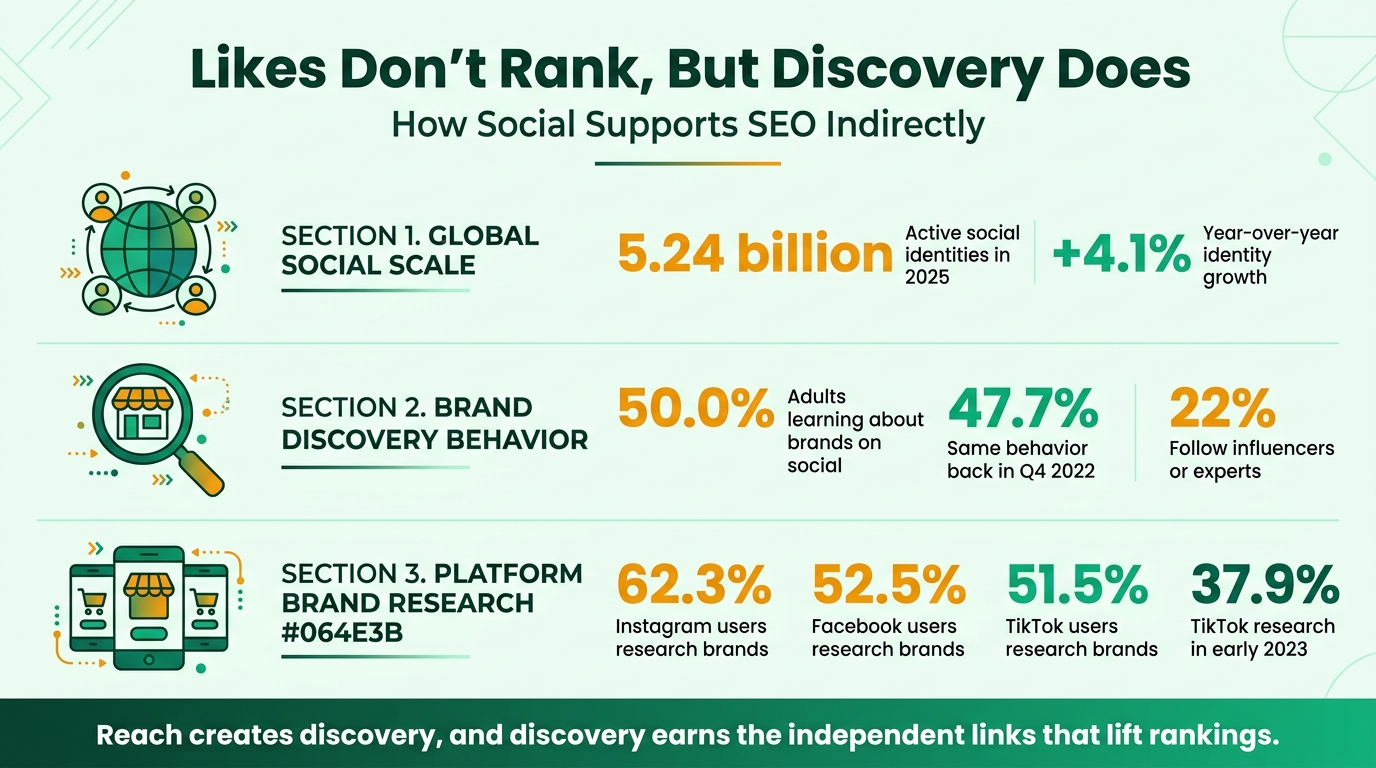
Social Signals Impact Statistics for Startups
Conclusion: what startups should do next
Do not buy likes or chase shares as a ranking tactic. Use social for discovery and distribution: get your best asset in front of relevant people so you can earn independent links and relevant listings.
Run one small experiment. Publish one useful page, share it with one relevant audience, and record referrals, leads and new referring domains. Some search changes take hours and others take months, so wait a few weeks to assess the effect. Google offers no guarantee that your site will be indexed or that a change will produce noticeable results.[1]
Keep directories selective and your expectations realistic. If manual submissions slow you down, relevant manual directory listings can complement social distribution as an off-page tactic.
FAQs
What are social signals in SEO?
Social signals are engagement metrics such as likes, shares and comments. Follower counts describe the size of an audience, but neither metric is an editorial vote from another site.
Do likes and shares directly improve Google rankings?
No—likes and shares are not confirmed direct Google ranking factors. They can help people discover your content and may lead to referral visits or independent links.
Are social media links the same as backlinks?
No. Social posts distribute a URL, and links from personal accounts are often no-followed and quickly buried. An editorial backlink is an independent publisher’s choice to cite your page, and a crawlable link can help Google find and assess it.[7]
How can startups use social media to earn backlinks without buying engagement?
Create one useful asset, such as a guide, template, benchmark or data story, and share it where your niche is active. Build genuine relationships by commenting thoughtfully and helping others, and make your work useful enough for publishers to cite.
How should startups choose startup directories that are safe for SEO?
Choose directories that fit your niche, attract real visitors, review submissions and provide accurate profiles that can be crawled and indexed. Avoid low-quality directories created primarily to manipulate rankings, and track referrals and leads instead of submission count.
Stop doing this manually
We list your startup in 120+ relevant directories — by hand
Every submission is done manually and delivered in a live report with profile links, logins and screenshots, so you can verify each backlink yourself. From $99, one-time.



Leave a Reply