

One of the most common domain rating misconceptions is that DR is a Google score. It is not. DR is an Ahrefs estimate of a domain’s backlink-profile strength, not a ranking factor, traffic promise, or page-quality grade.[1]
If you run a startup, you do not need a higher vanity number. You need indexed links that send qualified visits and leads without wasting weeks on manual research.
- DR is logarithmic, relative, and site-wide, so a move from 20 to 21 is much easier than 70 to 71.[1][7]
- High DR can exist with zero traffic and can be inflated, so pair it with rankings, traffic, and page checks.[6][1]
- Google ranks pages using many signals, including link analysis and PageRank, not DR itself.[2]
- For directories, relevance and listing quality beat headline DR. Low-quality scaled listings risk spam issues.[3]
What Domain Rating actually measures
“Domain Rating (DR) is an Ahrefs metric that shows the relative strength of a website’s backlink profile. DR is measured on a logarithmic scale from 0 to 100, with the latter being the strongest.”
— Ahrefs, Creator of DR metric (as quoted)[6]
Think of DR as link popularity compared to every other domain Ahrefs has seen. The scale runs from 0 to 100 and is logarithmic, which means the gaps widen at the top.[1] Going from 20 to 30 is far easier than going from 70 to 80.[7]
The simplified math looks like this: find followed linking domains, weight them by their own DR, then divide by how many unique domains each one links to.[1] Only the first followed link from a domain counts for DR, and nofollow links add nothing. Ahrefs does not disclose the exact formula.
DR is purely link-based. It does not consider search traffic, domain age, or brand popularity.[1] It is also domain-wide, not page-level. A meticulous Wikipedia article and a rough stub on the same domain share the same DR.[7]
| What DR is | What DR is not | What Google actually uses |
|---|---|---|
| A third-party estimate of backlink-profile strength on a 0–100 logarithmic scale.[1] | Not a Google ranking factor or penalty shield. | Page-level systems that assess pages using many factors and signals.[2] |
| A relative score that depends on other domains too. | Not a traffic or lead guarantee. | Link analysis and PageRank as parts of core ranking systems, not the whole system.[2] |
| A domain-wide number that applies to every page on the domain.[7] | Not a page-quality grade. | Site-wide signals can contribute, but they do not ensure every page will rank highly.[2] |
Ahrefs built DR to compare link popularity, shortlist prospects, and find similar-strength competitors for keyword ideas.[1] It was never meant as a target to inflate on its own.
6 domain rating misconceptions debunked
Myth 1: High DR means Google will rank you higher
Verdict: False. An analysis of 11.8 million results found that average DR rose with higher positions, but that is correlation, not causation.[5] Google says its systems are designed to work at page level, and good site-wide signals do not mean every page will rank highly.[2]
A strong domain can still have a weak target page. Evaluate the page you want to rank and the actual directory profile page separately. Link analysis and PageRank are only part of Google’s core systems.[2]
Myth 2: High DR guarantees search traffic
Verdict: False. In one small paid experiment, a test site reached DR 51 on December 26, 2023, and DR 60 on March 25, 2024, yet had no rankings and zero traffic in the Ahrefs checker.[6] Across the web, 96.55% of pages get zero search traffic from Google.[4]
Founders can overpay for a high-DR placement that no one visits. Check the directory’s organic traffic, its ranking keywords, and whether its listing pages are indexed and actually visited.
Myth 3: Any link from a high-DR site passes huge value
Verdict: Misleading. The DR value a domain can pass is divided by the number of unique domains it links to.[1] TechCrunch links to nearly 100,000 other websites, so the share passed to any one site is relatively small.[1]
Nofollow links do not increase DR, and only the first link from a domain counts.[1] Ask whether your listing link is followed, whether it sits on a real profile page or is buried, and how many outbound links the directory carries.
Myth 4: DR only moves when you gain or lose links
Verdict: False. DR is relative, so your score can fall with zero links lost if other sites gain links, your donors weaken, or your donors link out to more sites.[1]
Do not panic over a 1–2 point wobble. Compare trends over time and look at referring domains and donor changes, not the headline number alone.
Myth 5: Links from low-DR sites are worthless
Verdict: False. Ahrefs’ prospecting advice contrasts a DR 25 blog with a DR 80 publication and notes that relevant low-DR links can still help a page rank.[1] In an analysis of 11.8 million results, the No. 1 result averaged 3.8 times more backlinks than positions 2–10, and diversity of linking domains correlated with rankings.[5]
For a startup, a niche directory read by your buyers can beat an irrelevant high-DR list for topical fit and referrals. Do not filter out a relevant site on score alone.
Myth 6: Directory links are always good — or always spam
Verdict: Neither. Google lists low-quality directory or bookmark-site links as examples of link spam, alongside automated link creation and excessive link exchanges.[3] That targets low-quality tactics, not every directory.
DR does not account for spam, so large quantities of low-quality backlinks may still raise the score.[1] In a small paid test, five contractors charged $15–$85 each, $275 in total; after two months, the average cost to reach DR 50 was $50.[6] A score boost is not proof of quality. Choose selective, useful, manually created listings over scaled automation.
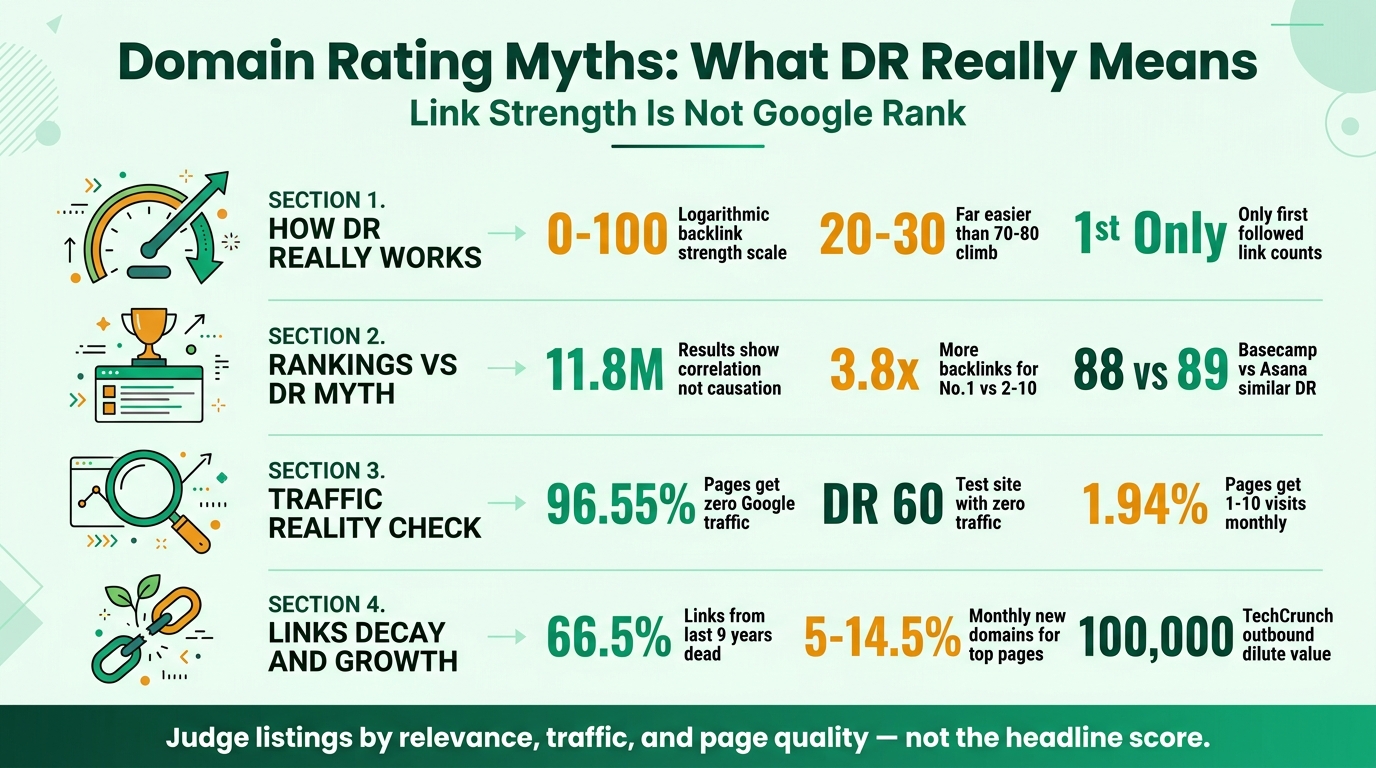
Domain Rating Impact Statistics for Startups
What to check instead of chasing a higher score
Use this triage before you submit anywhere. First, check page-level fit: is the actual listing page indexable, in the right category, with unique company information and a link? Second, check relevance and audience: will customers, partners, or press find you there?
Third, check traffic and intent. Look at the directory’s own rankings and referral potential. Only 1.94% of pages get 1–10 monthly visits from Google, so placement matters.[4] A live profile no one can find helps no one.
Think about durability too. Across the web, 66.5% of links to sites in the last nine years are dead, so prefer maintained directories that keep profiles live.[4] Higher-ranking pages tend to earn new followed referring domains at a steady monthly pace of 5% to 14.5%; this was a positive correlation across 10,000 SERPs.[4] Build steadily, not in one blast.
You can use similar-DR competitors for ideas, like Basecamp at 88 versus Asana at 89, without expecting the same rankings.[1] Ahrefs made its DR API endpoint free on June 9, 2026, making the score easier to look up.[7] Treat it as a first filter, not proof.
How to vet startup directories without chasing DR
Run every opportunity through this original 7-step checklist before you spend time on it:
- Relevance to your industry, stage, and geography
- Real human audience plus its own search visibility
- Listing quality: unique description, logo, links, and correct category
- Link attributes and indexability: followed versus nofollow or sponsored, and whether the profile URL can be indexed
- Editorial selectivity versus auto-accept of anyone
- Reporting proof: live URL, login details, and screenshot
- Referral and lead tracking plan after publication
That workflow is why selective execution matters. For example, SR Booster agents manually select relevant directories from a pool of 120+, create the listings, and deliver a live report with links, logins, and screenshots in about two weeks.Learn about the manual directory submission service.
Skip red flags that map to spam policy: bulk low-quality lists, automated submissions, required unqualified links, and keyword-stuffed widgets or footers.[3] If a tactic exists mainly to manipulate rankings, avoid it.
What your DR score means for next steps
Your DR is a relative popularity signal to shortlist opportunities and compare profiles. It is not a goal to inflate. Traffic depends on more than DR: useful pages, clear relevance, and quality links all matter.[1][2]
Apply a simple rule: if a directory is relevant, maintained, indexable, and able to send the right visits or inquiries, proceed even when its score looks modest. If it is irrelevant, unindexed, or low-quality, pass even when its score looks impressive.
Focus your next two weeks on fixable wins: tighten your positioning, get listed where buyers actually browse, and track referrals. If you want help with manual directory submission and reporting, SR Booster also offers a white-label option for agencies. Explore the directory service.
FAQs
Is Domain Rating a Google ranking factor?
No. Ahrefs defines DR as a third-party metric for backlink-profile strength.[1] Google uses its own page-level ranking systems, with link analysis and PageRank as only part of those systems.[2]
Can a website have high DR but little or no organic traffic?
Yes. A small experiment tracked a site that reached DR 60 while Ahrefs showed no rankings or organic traffic.[6] Check a site’s traffic and rankings separately from its DR.
Why did my DR drop when I did not lose backlinks?
DR is relative, so a score can slip even when your link count stays the same. Other sites may gain links, your referring domains may lose strength, or they may link to more sites.[1]
Do nofollow links increase Ahrefs DR?
No. Nofollow links do not increase DR, and only the first followed link from a referring domain counts toward the score.[1]
Are startup directory backlinks useful for SEO?
They can be useful when the directory is relevant, maintained, and reaches a real audience. Avoid bulk low-quality or automated listings, which Google identifies as link-spam examples.[3]
Stop doing this manually
We list your startup in 120+ relevant directories — by hand
Every submission is done manually and delivered in a live report with profile links, logins and screenshots, so you can verify each backlink yourself. From $99, one-time.



Leave a Reply