

A natural backlink profile isn’t a big one — it’s a believable one. Google reads the shape of your links — where they come from, what type they are, what the anchors say, and whether the sources are topically related — not a raw count[2]. Which means natural backlink profile building is a sequencing problem, not a volume problem.
Here’s the short version for a startup with a young domain and no PR budget:
- Most pages never earn links at all. In an Ahrefs sample of over one billion URLs, 66.31% of pages had zero backlinks[4]. Waiting for links to “happen” is not a strategy.
- Layer 1 — Trust base: consistent citations and listings on relevant startup directories that prove you exist and place you in the right category.
- Layer 2 — Demand assets: original data, calculators, templates, comparison pages — things publishers can actually cite.
- Layer 3 — Topical PR: pitch trade and niche publishers once you have a product, users, and numbers worth quoting.
- Where startups self-sabotage: exact-match money anchors, copy-pasted listing copy, and one giant burst of links in week one.
1. What Google Actually Reads as a Natural Backlink Profile
Your backlink profile is the full portfolio of links pointing at your domain. A healthy one is messy in a specific way.
“Healthy link profiles contain a mix of dofollow, nofollow, sponsored, and mentions from actual users in forums, communities, and social media shares.”
— Adam Riemer, President, Adam Riemer Marketing[1]
Profile health comes down to four pillars[2]:
- High-authority editorial links — links given inside real content, not placed by you.
- Referring-domain diversity — many distinct sites, not 400 links from one blog.
- Link-type diversity — editorial, directory, profile, social, sponsored.
- Anchor-text diversity — branded, naked URLs, generic, and only some keyword anchors.
The pillar most founders skip is relevance. Topical fit matters more than a third-party score like DA or AS, and links from unrelated sites, PBNs, or link wheels make a profile look manufactured[1]. A DR 70 link from a generic “business tips” site does less for a fintech tool than a DR 30 link from a fintech newsletter.
1.1 Benchmarks to Calibrate Your Expectations
Numbers help you size the gap without panicking about it:
| Benchmark | Number | What it means for you |
|---|---|---|
| Backlinks to top-ranking pages | ~3,800 on average, vs ~1,000 for positions 2–10[3] | Head terms are a multi-year game; start with long-tail pages |
| Top domains with 1,000+ unique referring domains | 96.3%[3] | Diversity of domains beats volume of links |
| Reported dofollow / nofollow split in a sample profile | 75.22% / 24.78%[2] | A 100% dofollow profile looks bought, not earned |
| Pages with no backlinks at all | 66.31% of 1B+ URLs[4] | Links need a reason to exist — usually an asset or a mention |
One caution before you chase those figures: a site that hasn’t done anything noteworthy yet has no reason to have earned links, so forcing volume early produces exactly the pattern Google distrusts[1].
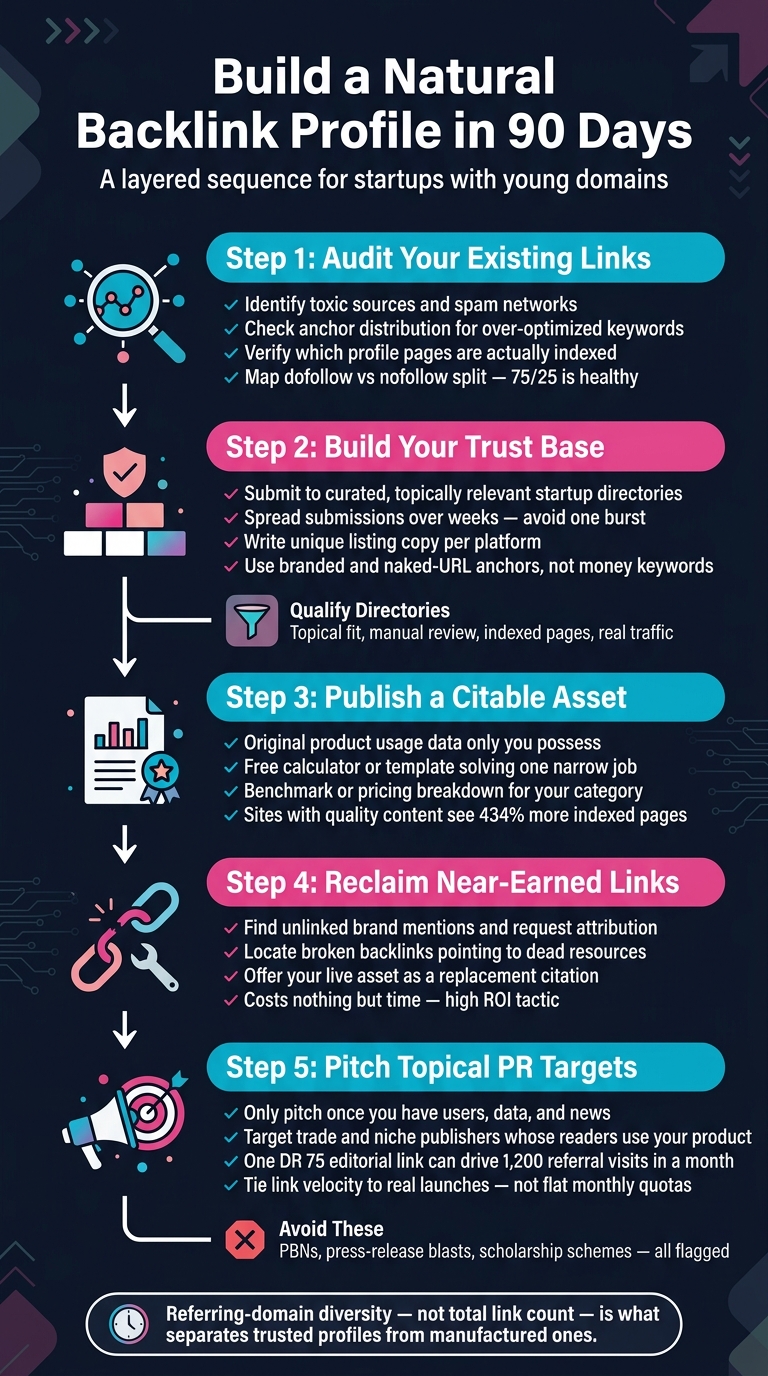
90-Day Natural Backlink Profile Building Roadmap for Startups
1.2 Why Startups Cannot Copy Enterprise Link Playbooks
Competitor gap analysis is useful for direction and useless as a to-do list. A report telling a six-month-old domain it “needs 2,400 links to compete” isn’t a plan — it describes a company that has existed for eight years, raised money, and shipped things people wrote about.
Reframe the year-one goal: establish verifiable existence and category placement first, then compound.
2. Layer 1: Build a Trust Base With Relevant Startup Directories
This layer does one job. It creates consistent, findable citations — name, description, category, URL, founder details — that confirm the company is real and put it in the right topical neighborhood. Same logic as local citations, applied to a product category instead of a city.
Not all directories qualify. Low-quality “add your URL” business directories are the ones flagged as toxic-profile contributors[2]. Curated startup and industry directories are different. Use four criteria:
- Topical or category fit — your product belongs in a category that exists on the site.
- Real editorial or manual review — someone approves listings.
- Indexed profile pages — search the directory’s domain plus a listed company name; if profiles aren’t indexed, the link does nothing.
- Genuine visitor traffic — the listing can actually send clicks.
A mix of nofollow and dofollow directory links is normal here, and it keeps your overall follow/nofollow balance looking ordinary rather than engineered[1][2].
2.1 Keeping Directory Links Natural, Not a Link Scheme
- Vary anchors. Lean on branded and naked-URL forms. Repeating one money keyword across 120 listings is the fastest way to look automated.
- Write unique listing copy per platform. The same paragraph everywhere means duplicate profiles and weaker approval rates.
- Spread submissions over weeks. Steady beats one burst.
- Stop at relevance. Skip lists where your product doesn’t fit, however easy the submission is.
Some incidental directory and tool-generated links are a normal part of a healthy profile — the problem starts when they’re the entire profile[1].
2.2 Turning Submissions Into Traffic, Not Just Links
Good directories send qualified referral visits, early signups, and reviews. Those are brand-demand signals, and they’re what makes Layer 3 possible later — publishers cite tools people already use.
The catch is operational. Researching each site, creating accounts, confirming emails, formatting copy, and verifying that the listing went live is slow, repetitive work. That’s the gap SR Booster’s manual startup directory submission service fills: manual listings across 120+ relevant directories, delivered as a report with profile links, logins, and screenshots. It’s an execution layer for the trust base — not a way around relevance.
3. Layer 2: Create the Assets and Demand That Earn Links
The order matters more than the tactics: create audience demand → publish resources worth citing → then do outreach[1]. Most startups run it backwards, then wonder why 200 cold emails produced two links.
Assets that actually get cited in a startup context:
- Original product usage data — anonymized numbers only you have.
- Pricing or benchmark breakdowns for your category.
- Free calculators or templates that solve one narrow job.
- Integration and comparison pages — these earn partner links and get referenced in buying discussions.
- A public changelog or launch page that gives people a stable URL to point at.
Publishing volume helps discovery too: sites publishing high-quality blog content have seen a 434% increase in indexed pages, which simply means more surfaces where a link can land[5].
3.1 Reclaiming Links You Have Already Almost Earned
Two tactics still work and cost nothing but time: fixing unlinked brand mentions and broken backlinks[7]. Someone already wrote about you, or already cited a resource that’s now dead — you’re just completing the transaction.
Frame it as a user-first move: offer your updated resource to replace a dead or missing citation on a page that already covers the topic[1]. The editor gets a fixed page; you get a contextual link.
3.2 Anchor Text and Link Velocity Rules for Year One
Weight your anchor mix toward naked URLs, branded anchors, and generic anchors, with only a small share of keyword anchors. Over-using exact-match money anchors and mass guest posting are known spam triggers[2].
For velocity, drop the flat “30 links a month” quota. Tie growth to real events — launches, funding, releases, integrations — because that’s what natural link curves look like: quiet stretches with spikes around news.
4. Layer 3: Topical PR and Editorial Links Once You Have Signal
The trigger for this layer is simple: you have a product, users, data, and category placement, so a publisher has a reason to mention you.
Target trade publications, niche publishers, industry blogs, and events whose readers would actually use your product. Mismatched outreach targets produce links that look unnatural and get devalued anyway[1]. PR is also moving toward campaigns that build brand demand and bring real customers rather than campaigns measured in link counts[9] — which matches how off-page SEO is now framed around trustworthiness and authority instead of raw volume[6].
4.1 What One Genuinely Relevant Editorial Link Can Do
A documented example: a healthcare client earned a single editorial backlink from a medical journal (DR 75, 200,000+ monthly organic visitors). It produced 1,200 referral visits in the first month, plus gains on competitive keywords[2].
“A good backlink is one that not only improves SEO metrics but also drives relevant referral traffic.”
— Paul DeMott, CTO, Helium SEO[2]
“A good rule of thumb is that: if a link is easy to earn, then it probably doesn’t have much SEO value.”
— Marc Hardgrove, CEO, TheHOTH[2]
So the honest test for any link opportunity: would a real person click this and care?
4.2 Tactics That Look Natural vs. Tactics That Backfire
| Tactic | How it appears to Google | When it’s safe for a startup | Risk if overused |
|---|---|---|---|
| Curated startup directory listings | Normal category citation[1] | Months 0–3, as the trust base | Low — unless it’s 100% of the profile |
| Topically relevant PR and citations | Editorial endorsement[2] | Once you have data, users, or news | Low |
| Broken-link reclamation | Helpful replacement of a dead source[7] | Anytime you have a matching resource | Low |
| Unlinked mention outreach | Completing an existing reference[7] | Anytime people mention you | Low |
| Guest posting | Contributed content; fine in moderation[2] | Occasional posts on relevant sites | High at scale — mass guest posts read as a scheme |
| Sponsorships and paid placements | Acceptable if marked sponsored[1] | When the audience matches your buyer | Medium — unmarked paid links are link buying |
| Press-release blasts | Syndicated duplicate links[1] | Real news only, for coverage not links | High — commonly neutralized |
| Scholarship / grant link schemes | Recognizable link-scheme pattern[1] | Essentially never, for SEO purposes | High |
| PBNs and link farms | Manufactured network[1] | Never | Severe — devaluation or manual action |
Scholarship, grant, and press-release-style schemes get neutralized most often once they dominate a profile[1]. So how do you tell whether your current profile already has these problems?
5. Auditing and Measuring Your Natural Backlink Profile
Run this diagnostic quarterly and map each finding to an action[2]:
- Toxic links → disavow only clear spam networks; ignore harmless junk.
- Low-quality directories → stop submitting; remove listings you control.
- Comment spam → find the source (often an old agency or tool) and shut it off.
- Over-optimized anchors → dilute with branded and naked-URL anchors going forward.
- Irrelevant, non-contextual placements → stop buying that inventory.
Track five metrics instead of “total backlinks”: new referring domains, dofollow/nofollow split, anchor distribution, referral traffic per source, and share of links that are indexed.
That last one is where startup link building quietly fails — an unindexed link delivers nothing. Check that profile pages are crawlable and indexed, keep listing content unique so pages aren’t filtered as duplicates, and re-check placements after any delivery window closes. A report with verifiable profile links and screenshots is more useful here than a number in a dashboard.
And keep links in proportion: under current Google systems, backlinks are one of several visibility levers, not the only one[8].
Conclusion: Build Trust First, Then Earn Links in Layers
Natural means diverse and relevant, not large. Two-thirds of pages on the web have no backlinks at all[4], so a deliberate sequence beats opportunistic volume. Referring-domain diversity — not link count — separates strong profiles from weak ones[3]. Directories and citations are the first layer, demand assets the second, topical PR the third. Anchors and velocity are where startups most often sabotage themselves[2].
A 90-day starting sequence:
- Weeks 1–2: Audit existing links — toxic sources, anchor distribution, indexing status.
- Weeks 2–8: Submit to relevant startup directories, spread out, with unique copy.
- Weeks 4–8: Publish one genuinely citable asset (data, calculator, or benchmark page).
- Weeks 8–10: Reclaim unlinked mentions and fix broken backlinks.
- Weeks 10–12: Pitch two topically relevant publications with something new to say.
If step two is the part your team keeps postponing — and it usually is, because it’s hours of research, sign-ups, and verification — SR Booster handles the manual directory layer for startups and agencies and hands back a live report instead of a spreadsheet of maybes. The strategy stays yours; the repetitive part gets done.
FAQs
Are backlinks still relevant in 2026?
Yes, but with less weight than a decade ago. Off-page SEO is now judged on trustworthiness and authority rather than raw link volume[6], and backlinks are one of several visibility levers under current Google systems[8]. Relevant links that send real referral traffic still matter; bulk links matter less every year.
What is a good number of backlinks for a new startup website?
There’s no fixed target — aim for referring-domain diversity instead. For context, 96.3% of top-ranking domains have more than 1,000 unique referring domains, and top pages average roughly 3,800 backlinks[3]. In year one, 100–150 relevant, indexed referring domains built steadily is a far healthier outcome than 1,000 links from 20 sites.
Do startup directory submissions count as natural backlinks?
They do when the directory is topically relevant, manually reviewed, indexed, and has real visitors. Incidental directory and tool-generated links are a normal part of a healthy profile — the risk appears when they make up the whole profile[1]. Generic low-quality business directories are the ones flagged as toxic-profile contributors[2].
How do I find and remove toxic backlinks?
Pull your backlink list from a backlink tool and look for the standard warning signs: spam networks, low-quality directories, comment spam, over-optimized exact-match anchors, and irrelevant non-contextual placements[2]. Remove what you control, request removal where you can, and disavow only clear spam patterns. Most random low-quality links are ignored automatically and need no action.
How long does it take to build a natural backlink profile?
Expect the trust base within roughly two to three months, meaningful editorial links from month four onward, and compounding results across six to twelve months. Speed is limited by how much link-worthy substance you have — a site that hasn’t done anything notable yet has no reason to have earned links[1]. Growth tied to real launches and releases looks natural; flat monthly quotas don’t.
Stop doing this manually
We list your startup in 120+ relevant directories — by hand
Every submission is done manually and delivered in a live report with profile links, logins and screenshots, so you can verify each backlink yourself. From $99, one-time.



Leave a Reply